



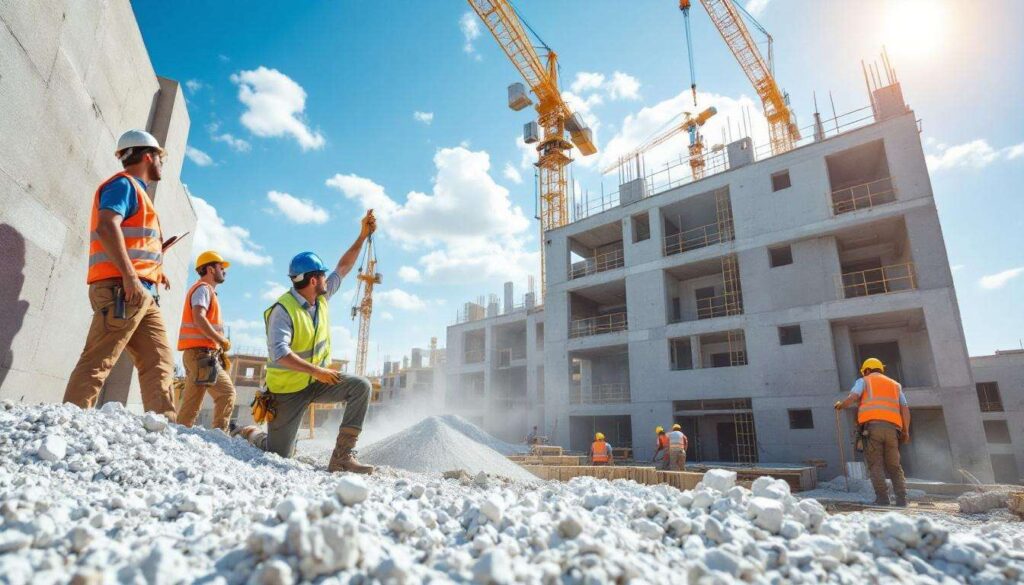
The construction industry stands at a critical juncture where innovation meets environmental responsibility. Researchers have developed a groundbreaking building material that not only reduces carbon emissions but actively absorbs CO₂ from the atmosphere whilst setting rapidly enough to meet modern construction demands. This advancement addresses two pressing challenges: the sector’s substantial carbon footprint and the urgent need for materials that support accelerated building timelines without compromising sustainability credentials.
Introduction to the CO₂ Absorbing New Material
Fundamental Composition and Discovery
The revolutionary material represents a calcium carbonate-based composite that undergoes a unique mineralisation process. Unlike conventional building materials that release significant quantities of carbon dioxide during production, this innovative substance captures atmospheric CO₂ as it cures. The material was developed through collaborative research between materials scientists and environmental engineers who sought to transform construction from a carbon-emitting industry into a carbon-negative solution.
The core technology relies on a chemical reaction where calcium hydroxide interacts with carbon dioxide to form calcium carbonate crystals. This process, known as carbonation curing, occurs naturally but has been enhanced and accelerated through precise formulation. The resulting material achieves structural integrity whilst simultaneously sequestering carbon, creating a dual benefit that traditional cement-based products cannot match.
Key Performance Indicators
Initial testing has demonstrated impressive capabilities across multiple metrics:
- Carbon capture rate of approximately 240 kilograms of CO₂ per tonne of material produced
- Setting time reduced to 24 hours compared to conventional concrete’s 28-day curing period
- Compressive strength matching or exceeding standard construction-grade concrete
- Water resistance suitable for both interior and exterior applications
- Thermal performance that contributes to improved building energy efficiency
These characteristics position the material as a viable alternative across numerous construction applications, bridging the gap between environmental necessity and practical functionality.
Characteristics of the Sustainable Construction Material
Physical Properties and Durability
The material exhibits exceptional structural properties that align with industry requirements for load-bearing applications. Its density ranges between 2,200 and 2,400 kilograms per cubic metre, comparable to traditional concrete whilst offering superior crack resistance. The rapid setting mechanism does not compromise long-term durability, with accelerated aging tests indicating a projected lifespan exceeding 50 years under typical environmental conditions.
The surface finish achieves a smooth texture suitable for architectural applications without requiring extensive post-processing. This aesthetic versatility enables architects to incorporate the material into designs without sacrificing visual appeal or requiring additional finishing materials that would increase the overall carbon footprint.
Chemical Stability and Safety
Comprehensive testing has confirmed the material’s chemical stability across varying pH levels and environmental exposures. The carbonation process creates a stable matrix that resists degradation from moisture, freeze-thaw cycles, and common atmospheric pollutants. Unlike some experimental materials, it contains no toxic compounds or volatile organic compounds, ensuring safe handling during construction and no off-gassing during building occupancy.
Understanding these characteristics helps stakeholders appreciate how this innovation translates into tangible advantages for construction projects and environmental goals.
Environmental and Economic Benefits
Carbon Footprint Reduction
The environmental impact represents the material’s most compelling attribute. Traditional cement production accounts for approximately 8% of global CO₂ emissions, making the construction sector a primary target for decarbonisation efforts. This new material reverses that equation by actively removing carbon dioxide from the atmosphere during the curing process.
| Material Type | CO₂ Emissions (kg per tonne) | Carbon Impact |
|---|---|---|
| Traditional Portland Cement | +900 | Positive emissions |
| CO₂ Absorbing Material | -240 | Carbon negative |
| Net Difference | 1,140 | Carbon savings |
Cost Implications and Market Viability
Economic analysis reveals that whilst initial production costs exceed traditional materials by approximately 15-20%, the total project economics become favourable when considering several factors. The rapid setting time reduces construction schedules, lowering labour costs and enabling faster project completion. Additionally, carbon credit programmes and green building incentives offset the material premium in many jurisdictions.
The reduced curing time translates directly into construction efficiency, potentially shortening project timelines by weeks or months depending on scale. This acceleration delivers financial benefits that extend beyond material costs to encompass financing expenses, earlier revenue generation for commercial projects, and reduced site management overheads.
These combined environmental and economic advantages create a compelling case for adoption, particularly as regulatory frameworks increasingly favour low-carbon construction solutions.
Manufacturing Process and Application
Production Methodology
The manufacturing process requires specialised mixing equipment and controlled environmental conditions to optimise carbon capture during production. Raw materials include calcium-rich industrial by-products, reducing reliance on virgin materials whilst providing beneficial reuse for waste streams. The production facility operates at ambient temperature, eliminating the energy-intensive heating required for traditional cement kilns.
Quality control protocols monitor particle size distribution, moisture content, and reactivity parameters to ensure consistent performance across batches. The material arrives at construction sites as a dry powder requiring only water addition, maintaining compatibility with existing mixing and placement equipment used by construction crews.
Installation Techniques
Application methods mirror conventional concrete placement procedures, minimising the training requirements for construction personnel. The material can be:
- Poured into formwork for structural elements
- Sprayed onto surfaces for coatings and repairs
- Pre-cast into modular components for off-site construction
- Extruded for three-dimensional printing applications
The rapid setting characteristic demands efficient workflow planning but rewards proper execution with dramatically reduced waiting periods before formwork removal and subsequent construction phases. This operational reality shapes how contractors approach project scheduling and resource allocation.
Comparison with Traditional Materials
Performance Benchmarking
Direct comparison with established construction materials provides context for evaluating this innovation’s practical viability. In compressive strength testing, the material achieves 40-50 megapascals within 24 hours, matching the 28-day strength of standard concrete mixes. Tensile strength characteristics require reinforcement strategies similar to conventional concrete, maintaining familiar design approaches for structural engineers.
Thermal conductivity measurements indicate improved insulation properties compared to traditional concrete, contributing to enhanced building envelope performance. This characteristic reduces heating and cooling demands, creating ongoing operational carbon savings beyond the initial construction phase benefits.
Limitations and Considerations
Transparency regarding constraints ensures realistic expectations for adoption. The material currently faces challenges including limited production capacity, regional availability restrictions, and the need for specific storage conditions to prevent premature carbonation. Additionally, long-term field performance data remains limited compared to materials with decades of documented use, requiring cautious specification in critical applications until extended monitoring confirms laboratory predictions.
These practical considerations inform how the construction industry can strategically integrate this technology whilst managing risk and maintaining project delivery confidence.
Future Prospects for the Sustainable Building Sector
Scaling Production and Market Penetration
Industry analysts project substantial growth potential as manufacturing capacity expands and regulatory frameworks increasingly mandate carbon reduction. Several major construction firms have initiated pilot projects to evaluate performance in real-world conditions, with early results supporting broader specification in commercial and residential developments.
The material’s success could catalyse a fundamental shift in construction industry practices, establishing carbon-negative building as a standard expectation rather than an exceptional achievement. This transformation requires coordinated efforts across material suppliers, contractors, architects, and regulatory bodies to update standards, training programmes, and procurement specifications.
Integration with Emerging Technologies
Compatibility with digital fabrication methods, particularly three-dimensional printing, positions this material at the intersection of sustainability and construction automation. The rapid setting characteristic aligns perfectly with additive manufacturing requirements, enabling complex geometries whilst maintaining the carbon capture benefits. This synergy could accelerate adoption in innovative housing solutions and disaster relief applications where speed and environmental performance both carry premium value.
The construction sector stands poised for transformation as materials science delivers solutions that reconcile environmental imperatives with practical building requirements. This CO₂-absorbing material exemplifies how innovation can address climate challenges whilst meeting the fundamental human need for shelter and infrastructure. As production scales and field experience accumulates, the technology promises to reshape construction practices towards a genuinely sustainable future where buildings contribute to atmospheric carbon reduction rather than emissions growth.