

Interior designers are signalling a significant shift in window treatments, with curtains taking centre stage as both functional elements and statement pieces. The convergence of environmental consciousness, technological advancement, and a desire for personalised living spaces is reshaping how we think about these essential home furnishings. From innovative fabrics that respond to light and temperature to bold patterns that challenge conventional aesthetics, the curtain industry is experiencing a renaissance driven by consumer demand for sustainability, smart functionality, and individual expression.
New materials for curtains: sustainability and innovation
Natural fibres making a comeback
The textile industry is witnessing a remarkable resurgence of natural fibres in curtain manufacturing. Designers are increasingly favouring materials such as organic cotton, linen, hemp, and bamboo for their environmental credentials and tactile qualities. These fabrics offer breathability, durability, and a distinctive aesthetic that synthetic alternatives struggle to replicate. Hemp, in particular, is gaining traction due to its minimal water requirements and rapid growth cycle, making it an exceptionally sustainable choice for eco-conscious consumers.
Recycled and upcycled textiles
Innovation extends beyond virgin materials, with recycled polyester derived from plastic bottles becoming a mainstream option. This material maintains the practical benefits of traditional polyester whilst significantly reducing environmental impact. Several leading manufacturers are now producing curtain fabrics containing up to 80% recycled content, demonstrating that sustainability need not compromise quality or appearance.
- Recycled ocean plastics transformed into elegant draping fabrics
- Post-consumer textile waste repurposed into contemporary curtain designs
- Industrial fabric offcuts reimagined as bespoke window treatments
- Vintage textiles restored and adapted for modern applications
Performance fabrics with ecological benefits
The development of performance fabrics that combine functionality with sustainability represents a significant breakthrough. These advanced textiles offer properties such as thermal insulation, UV protection, and moisture resistance whilst being manufactured from renewable resources. Designers are particularly excited about fabrics treated with natural, non-toxic finishes that enhance durability without relying on harmful chemicals.
These material innovations are intrinsically linked to the visual aspects of curtain design, where colour and pattern choices reflect broader cultural shifts.
Colour and pattern trends for 2026
Earth tones and biophilic palettes
The colour spectrum for curtains is shifting decisively towards earthy, grounded hues that evoke natural landscapes. Terracotta, ochre, sage green, and warm clay tones are dominating designer collections, reflecting a collective desire to bring the outdoors inside. These colours create calming environments whilst complementing the natural materials increasingly prevalent in interior design.
| Colour family | Specific shades | Psychological effect |
|---|---|---|
| Warm neutrals | Caramel, mushroom, sand | Comfort and stability |
| Green spectrum | Olive, moss, sage | Tranquillity and renewal |
| Earth reds | Terracotta, rust, burnt sienna | Warmth and grounding |
| Blue tones | Slate, petrol, teal | Serenity and focus |
Bold patterns and maximalist designs
Contrasting with the subdued colour palette, pattern choices are becoming increasingly bold and expressive. Designers are embracing oversized florals, abstract geometrics, and artistic prints that transform curtains into focal points rather than background elements. This maximalist approach allows homeowners to inject personality into their spaces through window treatments that function as textile art.
Tonal layering and texture
The concept of tonal layering is gaining prominence, with designers recommending curtains in similar colour families but varied textures to create depth and visual interest. This approach works particularly well with natural materials, where the inherent texture of linen or raw silk adds dimension without requiring contrasting colours.
As aesthetic preferences evolve, technological innovations are simultaneously transforming the functional capabilities of curtain systems.
The impact of technology on curtain design
Smart curtains and automated systems
The integration of smart home technology into curtain design represents one of the most significant developments in the industry. Motorised curtain tracks controlled via smartphone applications or voice commands are becoming standard features in contemporary homes. These systems offer programmable schedules that align with natural light patterns, enhancing energy efficiency whilst providing convenience.
- Voice-activated opening and closing through smart home assistants
- Solar-powered motors eliminating electrical wiring requirements
- Sensors that automatically adjust curtains based on sunlight intensity
- Integration with home security systems for occupancy simulation
Responsive and adaptive fabrics
Textile engineering has produced responsive fabrics that react to environmental conditions. Thermochromic materials change opacity based on temperature, whilst photochromic fabrics adjust their tint in response to UV exposure. These innovations provide dynamic light control without mechanical intervention, representing a fusion of material science and practical design.
Digital printing and customisation technology
Advanced digital printing techniques enable unprecedented customisation possibilities, allowing consumers to transfer personal photographs, artwork, or bespoke designs onto curtain fabrics with remarkable clarity and colour accuracy. This technology democratises custom design, making it accessible beyond luxury markets.
These technological capabilities complement emerging trends in curtain construction and styling that prioritise architectural impact.
Curtain shapes and structures to watch
Architectural draping and sculptural forms
Designers are moving away from conventional hanging methods towards architectural approaches that treat curtains as three-dimensional structures. Pleating techniques such as ripple fold, goblet, and box pleats are being reimagined to create dramatic visual effects that emphasise volume and movement. These sculptural treatments transform curtains from simple fabric panels into design statements.
Layered and multi-functional designs
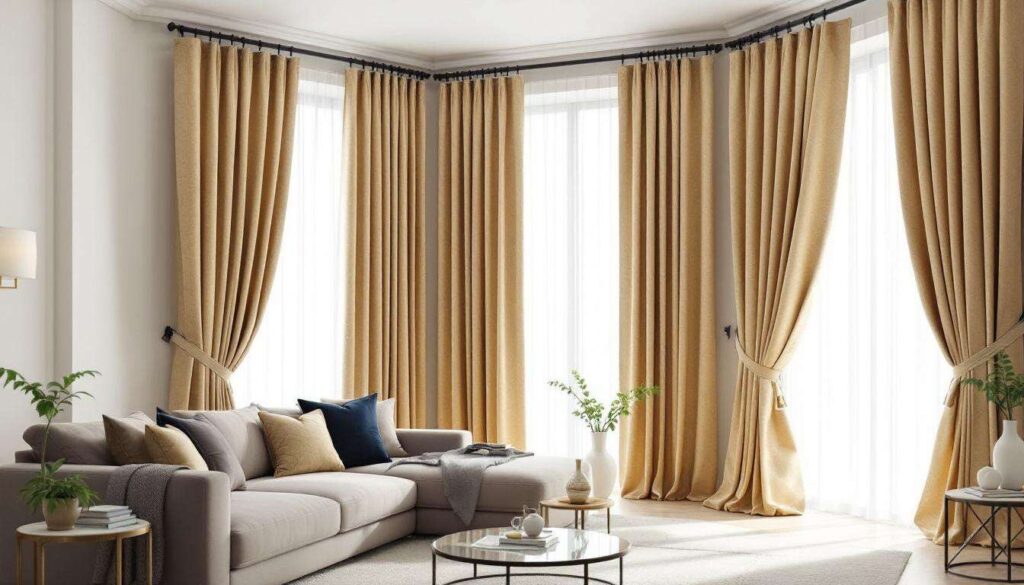
The layering of different curtain types is becoming standard practice, combining sheer fabrics with heavier drapes to provide flexible light control and privacy options. This approach allows homeowners to adjust their window treatments throughout the day, responding to changing light conditions and functional requirements.
| Layer type | Primary function | Recommended fabric |
|---|---|---|
| Sheer inner layer | Diffused light, daytime privacy | Linen voile, cotton gauze |
| Medium weight | Light filtering, partial privacy | Cotton blend, lightweight wool |
| Blackout outer layer | Complete darkness, insulation | Lined velvet, heavy cotton |
Minimalist hardware and concealed fixtures
The trend towards minimalist aesthetics extends to curtain hardware, with designers favouring concealed tracks and subtle fixtures that allow the fabric to take centre stage. Ceiling-mounted systems that extend from wall to wall create an illusion of greater space whilst providing clean, uninterrupted lines.
These structural innovations work in tandem with a broader movement towards personalisation that reflects individual taste and lifestyle requirements.
Customisation of curtains: towards a bespoke approach
Made-to-measure becoming mainstream
The bespoke curtain market is expanding beyond luxury segments as consumers increasingly value perfect fit and personalised design. Made-to-measure services now incorporate detailed consultations addressing window dimensions, light exposure, interior style, and functional needs. This shift reflects a rejection of mass-produced uniformity in favour of tailored solutions that complement specific architectural features.
Collaborative design processes
Designers are adopting collaborative approaches that involve clients throughout the creative process. Digital visualisation tools allow homeowners to experiment with different fabrics, colours, and styles within photorealistic renderings of their actual spaces before committing to final selections. This participatory design methodology ensures satisfaction whilst reducing waste from unsuitable choices.
- Virtual reality previews of curtain options in situ
- Sample libraries allowing tactile evaluation of materials
- Iterative design consultations refining aesthetic direction
- Detailed technical drawings ensuring precise installation
Modular and adaptable systems
Recognising that interior preferences evolve, designers are creating modular curtain systems that allow components to be easily changed or updated. Detachable decorative panels, interchangeable linings, and adjustable lengths enable curtains to adapt to changing seasons, relocated furniture, or shifting aesthetic preferences without requiring complete replacement.
This emphasis on personalisation aligns naturally with growing environmental awareness that extends beyond material choices to consider the entire lifecycle of curtain products.
Ecological impact: eco-friendly and biodegradable curtains
Lifecycle assessment and circular design
Leading designers are now considering the complete environmental footprint of curtains, from raw material extraction through manufacturing, use, and eventual disposal. This comprehensive approach, known as lifecycle assessment, informs decisions about material selection, production methods, and end-of-life options. Circular design principles prioritise durability, repairability, and recyclability to minimise waste.
Biodegradable and compostable options
The development of fully biodegradable curtains represents a significant advancement in sustainable design. Fabrics made entirely from natural fibres with plant-based dyes and natural finishes can decompose safely at the end of their useful life, returning nutrients to the soil rather than persisting in landfills. This closed-loop approach appeals to environmentally conscious consumers seeking to minimise their ecological impact.
| Material | Biodegradability period | Composting conditions |
|---|---|---|
| Organic cotton | 5-6 months | Home compost suitable |
| Hemp | 3-4 months | Home compost suitable |
| Bamboo fabric | 4-5 months | Home compost suitable |
| Linen | 2-3 months | Home compost suitable |
Local production and reduced carbon footprint
The localisation of curtain production is gaining momentum as designers and manufacturers recognise the environmental costs of global supply chains. Regional textile production, local dyeing facilities, and nearby fabrication workshops significantly reduce transportation emissions whilst supporting local economies. This geographical approach also enables greater quality control and faster response to design trends.
Transparent supply chains and ethical manufacturing
Consumers are increasingly demanding transparency regarding the ethical and environmental practices of curtain manufacturers. Designers are responding by partnering with suppliers who provide detailed information about working conditions, chemical usage, water consumption, and energy sources. Certifications such as GOTS (Global Organic Textile Standard) and OEKO-TEX provide third-party verification of environmental and social standards.
The curtain industry stands at a pivotal moment where aesthetic innovation, technological advancement, and environmental responsibility converge. Natural and recycled materials are replacing conventional synthetics, whilst smart technology enhances functionality without compromising sustainability. Colour palettes grounded in nature coexist with bold patterns that express individuality, and architectural draping techniques elevate curtains to sculptural elements within interior spaces. The movement towards bespoke design reflects a broader cultural shift valuing personalisation and quality over mass production. Perhaps most significantly, the embrace of biodegradable materials and circular design principles demonstrates that beautiful, functional curtains need not compromise planetary health. These emerging trends collectively suggest that window treatments will continue evolving as sophisticated design elements that balance aesthetic ambition with environmental stewardship.