


Kitchen design stands at a fascinating crossroads where functionality meets aesthetics, and innovation transforms daily routines. Top designers across the globe are reimagining these essential spaces, moving beyond traditional concepts to create environments that adapt to evolving lifestyles. From sustainable materials to intelligent appliances, the kitchen continues to evolve as the heart of the home, reflecting broader societal shifts towards environmental consciousness, technological integration, and personalised living. These emerging trends signal a departure from conventional design principles, offering homeowners unprecedented opportunities to craft spaces that truly reflect their values and needs.
Multifunctional spaces: the kitchen of the future
Beyond cooking: the multipurpose hub
The modern kitchen has transcended its traditional role as merely a cooking space. Designers predict that multifunctional kitchens will dominate residential architecture, serving as workspaces, entertainment zones, and family gathering areas simultaneously. This transformation reflects changing work patterns, with remote employment becoming increasingly common and households requiring versatile environments that accommodate diverse activities throughout the day.
Key features defining these adaptable spaces include:
- Integrated workstations with concealed charging points and cable management systems
- Flexible island configurations that convert from food preparation surfaces to dining tables or desk spaces
- Modular storage solutions that adapt to varying needs throughout the day
- Acoustic treatments that create distinct zones within open-plan layouts
- Adjustable lighting schemes that support different activities and moods
Zoning strategies for seamless functionality
Professional designers emphasise the importance of thoughtful zoning within multifunctional kitchens. Rather than creating rigid boundaries, the approach involves subtle spatial definitions that maintain visual continuity whilst establishing practical distinctions between different activity areas. Furniture placement, flooring transitions, and strategic lighting all contribute to this sophisticated layering of functions without compromising the sense of openness that contemporary homeowners value.
| Zone Type | Primary Function | Design Elements |
|---|---|---|
| Preparation Zone | Food preparation and cooking | Task lighting, durable surfaces, appliance integration |
| Social Zone | Dining and entertainment | Comfortable seating, ambient lighting, accessible storage |
| Work Zone | Remote work and study | Technology integration, ergonomic furniture, focused lighting |
This evolution towards multifunctionality naturally raises questions about the materials and finishes that can withstand such varied and intensive use, leading to increased interest in sustainable and durable options.
The rise of eco-friendly materials
Sustainable choices gaining mainstream appeal
Environmental consciousness has moved from niche concern to central design principle, with eco-friendly materials becoming standard specifications rather than premium alternatives. Designers predict widespread adoption of recycled, reclaimed, and rapidly renewable materials that reduce environmental impact without compromising aesthetic appeal or functionality. This shift reflects growing consumer awareness and a genuine desire to minimise the ecological footprint of home renovations.
Popular sustainable materials making significant inroads include:
- Recycled glass worktops offering durability and unique visual characteristics
- Reclaimed timber for cabinetry and feature walls, each piece carrying distinctive character
- Bamboo and cork flooring providing renewable alternatives to traditional hardwoods
- Low-VOC paints and finishes improving indoor air quality
- Recycled metal fixtures and fittings combining sustainability with industrial aesthetics
Performance meets environmental responsibility
The advancement of sustainable manufacturing processes has eliminated the traditional compromise between ecological credentials and practical performance. Modern eco-friendly materials frequently outperform conventional alternatives in terms of durability, maintenance requirements, and longevity. Manufacturers have invested heavily in research and development, producing materials that meet rigorous performance standards whilst maintaining impeccable environmental credentials.
| Material Category | Environmental Benefit | Practical Advantage |
|---|---|---|
| Recycled Composite Worktops | Diverts waste from landfills | Non-porous, stain-resistant surfaces |
| Reclaimed Wood | Preserves existing timber resources | Unique character and proven durability |
| Bamboo Products | Rapid regeneration (3-5 years) | Harder than many traditional hardwoods |
As materials become more sustainable, the systems that control and optimise kitchen environments are simultaneously becoming more sophisticated and intelligent.
Smart technology: the rise of smart kitchens
Connected appliances transforming daily routines
The integration of smart technology represents perhaps the most dramatic transformation predicted for kitchen design. Designers anticipate widespread adoption of interconnected appliances and systems that communicate seamlessly, learning user preferences and automating routine tasks. This technological revolution extends far beyond novelty features, offering genuine improvements in efficiency, food preservation, and energy consumption.
Essential smart kitchen technologies include:
- Intelligent refrigerators that monitor contents, suggest recipes, and alert users to expiring items
- Precision cooking appliances with remote control and automated programmes
- Voice-activated systems managing lighting, temperature, and entertainment
- Integrated inventory management linking to online shopping platforms
- Energy monitoring systems optimising consumption patterns
Seamless integration and intuitive interfaces
The success of smart kitchen technology depends heavily on intuitive design and seamless integration rather than overwhelming users with complex controls. Leading designers emphasise that technology should enhance rather than complicate daily routines, remaining largely invisible until needed. This philosophy drives the development of touchless controls, voice activation, and predictive automation that anticipates user needs based on established patterns and preferences.
These technological advances complement another significant shift in kitchen aesthetics, as designers predict a dramatic departure from the neutral palettes that have dominated recent years.
A return to vibrant colours
Bold palettes replacing neutral dominance
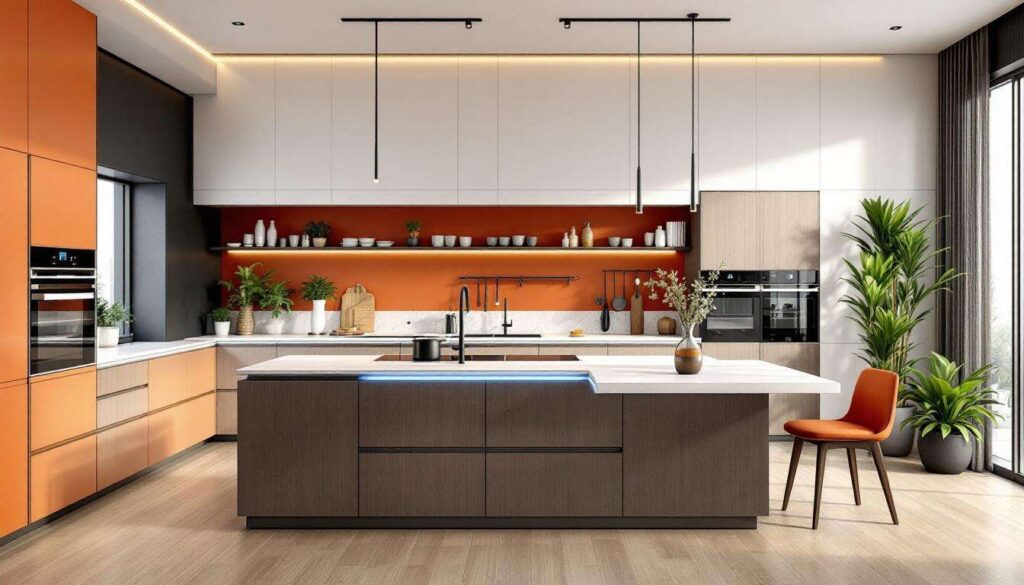
After years of white, grey, and beige kitchens, designers predict a dramatic resurgence of colour as homeowners seek to express personality and create distinctive spaces. This trend encompasses rich, saturated hues applied to cabinetry, walls, and even appliances, moving away from the safe neutrality that has characterised kitchen design for the past decade. The shift reflects broader cultural movements towards individuality and the rejection of generic, showroom-perfect aesthetics.
Anticipated colour trends include:
- Deep forest greens creating connections with nature
- Warm terracotta and rust tones introducing earthy sophistication
- Navy and midnight blues offering dramatic yet timeless appeal
- Jewel tones like emerald and sapphire adding luxurious touches
- Two-tone cabinetry combining complementary or contrasting colours
Strategic colour application for maximum impact
Professional designers recommend strategic colour placement rather than overwhelming entire spaces with intense hues. This measured approach involves accent islands, feature walls, or lower cabinetry in bold colours whilst maintaining lighter tones elsewhere to preserve brightness and visual space. The technique allows homeowners to embrace colour trends without committing to schemes that might feel overwhelming or quickly dated.
This renewed embrace of colour exists alongside another powerful trend that emphasises spatial clarity and functional simplicity.
Open and minimalist design
Streamlined aesthetics and spatial flow
The principles of minimalist design continue evolving, with designers predicting refined interpretations that emphasise quality over quantity and function over decoration. This approach prioritises clean lines, uncluttered surfaces, and thoughtful storage solutions that conceal everyday items whilst maintaining easy accessibility. The aesthetic reflects a broader lifestyle philosophy that values intentional living and the elimination of unnecessary possessions.
Core elements of minimalist kitchen design include:
- Handleless cabinetry with push-to-open mechanisms creating seamless surfaces
- Integrated appliances concealed behind matching cabinet fronts
- Concealed storage maximising capacity whilst maintaining visual simplicity
- Continuous worktop materials eliminating visual breaks and joints
- Reduced upper cabinetry replaced by open shelving or blank walls
Functionality within simplicity
Successful minimalist kitchens require exceptional planning to ensure that simplified aesthetics do not compromise practical functionality. Designers emphasise the importance of comprehensive storage solutions that accommodate all necessary items without visible clutter. This demands careful assessment of household needs, cooking habits, and storage requirements during the planning phase, ensuring that minimalist principles enhance rather than restrict daily kitchen use.
| Design Element | Aesthetic Benefit | Functional Benefit |
|---|---|---|
| Handleless Cabinetry | Clean, uninterrupted lines | Easier cleaning, no protruding elements |
| Integrated Appliances | Cohesive visual appearance | Streamlined workflow, space efficiency |
| Concealed Storage | Uncluttered surfaces | Protected contents, organised systems |
Kitchen design trends for the coming years reflect fundamental shifts in how households function, environmental priorities, and technological capabilities. The movement towards multifunctional spaces acknowledges changing work patterns and the need for adaptable environments. Sustainable materials address growing environmental consciousness whilst delivering exceptional performance. Smart technology promises genuine improvements in efficiency and convenience when thoughtfully integrated. The return to vibrant colours signals a rejection of generic neutrality in favour of personal expression. Meanwhile, minimalist principles continue refining spatial clarity and functional efficiency. These converging trends offer homeowners unprecedented opportunities to create kitchens that truly reflect individual values, lifestyles, and aspirations whilst embracing innovation and sustainability.