



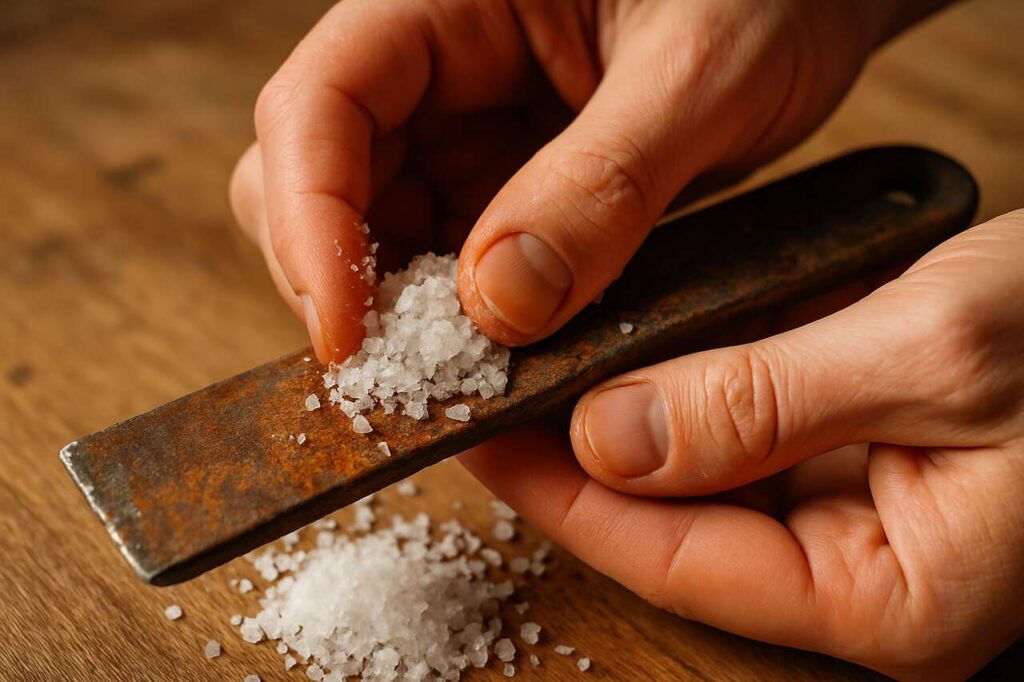
Rust represents one of the most persistent challenges for anyone who works with metal tools. Whether professional tradespeople or weekend DIY enthusiasts, the sight of orange-brown corrosion spreading across cherished equipment can be disheartening. Yet a remarkably simple household ingredient offers an effective solution: salt. This crystalline substance, combined with minimal effort and basic technique, can restore rusted tools to their former condition without expensive chemical treatments or specialised equipment.
Understanding the phenomenon of rust on tools
The chemical process behind corrosion
Rust forms through a chemical reaction called oxidation, where iron in metal tools combines with oxygen and moisture in the environment. This process creates iron oxide, the reddish-brown substance that gradually eats away at metal surfaces. The reaction accelerates in humid conditions or when tools are exposed to water without proper drying. Understanding this mechanism helps explain why prevention and timely treatment matter so significantly for tool longevity.
Common scenarios that lead to tool rust
Several everyday situations contribute to rust formation on tools:
- Storing tools in damp sheds or garages without climate control
- Leaving equipment outdoors after use, exposed to rain or morning dew
- Failing to dry tools properly after cleaning or working in wet conditions
- Storing tools in toolboxes without adequate ventilation
- Exposure to salt air in coastal environments
The severity of rust varies from surface discolouration to deep pitting that compromises structural integrity. Early intervention prevents minor surface rust from developing into more serious damage that can render tools unusable.
Recognising how rust develops naturally leads to exploring practical solutions that can reverse this deterioration.
Why salt scrubbing is effective against rust
The abrasive properties of salt crystals
Salt functions as a mechanical abrasive that physically removes rust from metal surfaces. The crystalline structure of salt provides just enough hardness to scrape away oxidation without damaging the underlying metal. Unlike harsh chemical rust removers, salt offers a gentle yet effective approach that works through physical action rather than corrosive reactions. The irregular edges of salt crystals create microscopic cutting surfaces that lift rust particles when rubbed against affected areas.
Chemical interactions that enhance rust removal
Beyond its abrasive qualities, salt contributes to rust removal through chemical means. When combined with acidic substances like lemon juice or vinegar, salt creates an environment that helps dissolve iron oxide. The chloride ions in salt can also interact with rust, breaking down its molecular bonds and making it easier to remove. This dual-action approach explains why salt scrubs outperform simple mechanical scrubbing with other abrasives.
| Method | Effectiveness | Cost | Safety |
|---|---|---|---|
| Salt scrub | High | Very low | Excellent |
| Chemical rust remover | Very high | Moderate to high | Requires precautions |
| Wire brush alone | Moderate | Low | Good |
| Sandpaper | Moderate | Low | Good |
With this understanding of salt’s effectiveness established, the practical preparation becomes the next consideration.
The steps to prepare a salt scrub
Gathering the necessary materials
Creating an effective salt scrub requires minimal ingredients and equipment. The basic components include coarse salt (table salt works, though sea salt or rock salt provides better abrasive action), an acidic liquid such as lemon juice or white vinegar, and a small bowl for mixing. Additional helpful items include protective gloves, old cloths or rags, a scrubbing brush with stiff bristles, and newspaper or plastic sheeting to protect work surfaces.
Creating the optimal scrub mixture
The preparation process involves straightforward steps:
- Pour approximately three tablespoons of coarse salt into a bowl
- Add one tablespoon of lemon juice or white vinegar to the salt
- Mix thoroughly to create a paste-like consistency
- Adjust proportions if needed: the mixture should be thick enough to adhere to vertical surfaces
- Allow the mixture to sit for two to three minutes before application
The proportions can be scaled up for larger projects, maintaining roughly a three-to-one ratio of salt to acidic liquid. Some practitioners add a small amount of water to adjust consistency, though this dilutes the chemical effectiveness slightly.
Once the scrub mixture reaches the proper consistency, applying it correctly determines the success of rust removal.
The practical application of the scrub to remove rust
Applying the mixture to affected areas
Begin by spreading the salt scrub generously over rusted sections of the tool. Use fingers (protected by gloves) or a cloth to ensure complete coverage of all corroded areas. For heavily rusted tools, apply a thicker layer and allow it to sit for five to ten minutes. This resting period lets the acidic component begin breaking down the rust chemically before mechanical scrubbing commences.
The scrubbing technique for maximum effectiveness
Effective scrubbing requires firm, circular motions using either a cloth, brush, or even a halved potato as an applicator. The pressure should be consistent but not excessive: the goal is to let the salt crystals do the work rather than relying on brute force. For stubborn rust patches, focus attention on those areas with additional scrub mixture and continued circular rubbing. Periodically wipe away the loosened rust to assess progress and reapply fresh mixture as needed.
Rinsing and drying procedures
After removing visible rust, thoroughly rinse tools with clean water to eliminate all salt residue. Remaining salt can attract moisture and potentially contribute to future corrosion. Dry tools immediately and completely using absorbent cloths, paying special attention to joints, crevices, and any recessed areas where water might collect. Some practitioners use compressed air to ensure complete drying in hard-to-reach spaces.
Successfully removing rust represents only half the battle; proper ongoing care prevents recurrence.
Tips for maintaining your tools after scrubbing
Protective coatings to prevent future rust
After cleaning and drying, apply a protective barrier to prevent oxygen and moisture from reaching the metal surface. Options include:
- Light machine oil applied with a cloth
- Specialised tool protection sprays
- Paste wax buffed to a thin coating
- WD-40 or similar water-displacing products
The protective layer need not be thick; a thin, even coating provides adequate protection without making tools greasy or difficult to handle.
Storage practices that minimise corrosion
Proper storage significantly extends the time between necessary rust treatments. Store tools in dry environments with good air circulation. Silica gel packets placed in toolboxes absorb ambient moisture. Avoid storing tools directly on concrete floors, which can transfer moisture. Hanging tools on pegboards promotes air circulation around all surfaces. For long-term storage, consider wrapping individual tools in cloth treated with rust-preventive compounds.
Beyond its utility for tools, salt offers surprising versatility in household applications.
The benefits of salt beyond cleaning tools
Additional household cleaning applications
Salt’s abrasive and chemical properties make it valuable throughout the home. It effectively cleans cast iron cookware without damaging seasoning, removes stains from cutting boards, and cleans copper and brass items when combined with vinegar. Salt also absorbs fresh spills, deodorises drains when flushed with hot water, and removes water rings from wooden furniture when made into a paste with oil.
Environmental and economic advantages
Using salt for cleaning represents an environmentally responsible choice compared to commercial chemical cleaners. Salt is non-toxic, biodegradable, and safe for septic systems. The economic benefits are equally compelling: a large container of salt costs considerably less than specialised rust removers whilst providing sufficient quantity for numerous applications. This combination of effectiveness, safety, and affordability makes salt an ideal household cleaning agent.
The humble salt crystal proves remarkably effective at lifting rust stains from metal tools through combined mechanical abrasion and chemical action. Preparing a simple mixture of coarse salt and acidic liquid creates a powerful yet safe rust remover that restores tools without expensive products or harsh chemicals. Proper application technique, followed by thorough rinsing, drying, and protective coating, ensures lasting results. Regular maintenance and appropriate storage practices prevent rust recurrence, extending tool life significantly. Salt’s versatility extends well beyond tool care, offering numerous household cleaning applications whilst remaining environmentally friendly and economically sensible.